


Key Takeaways
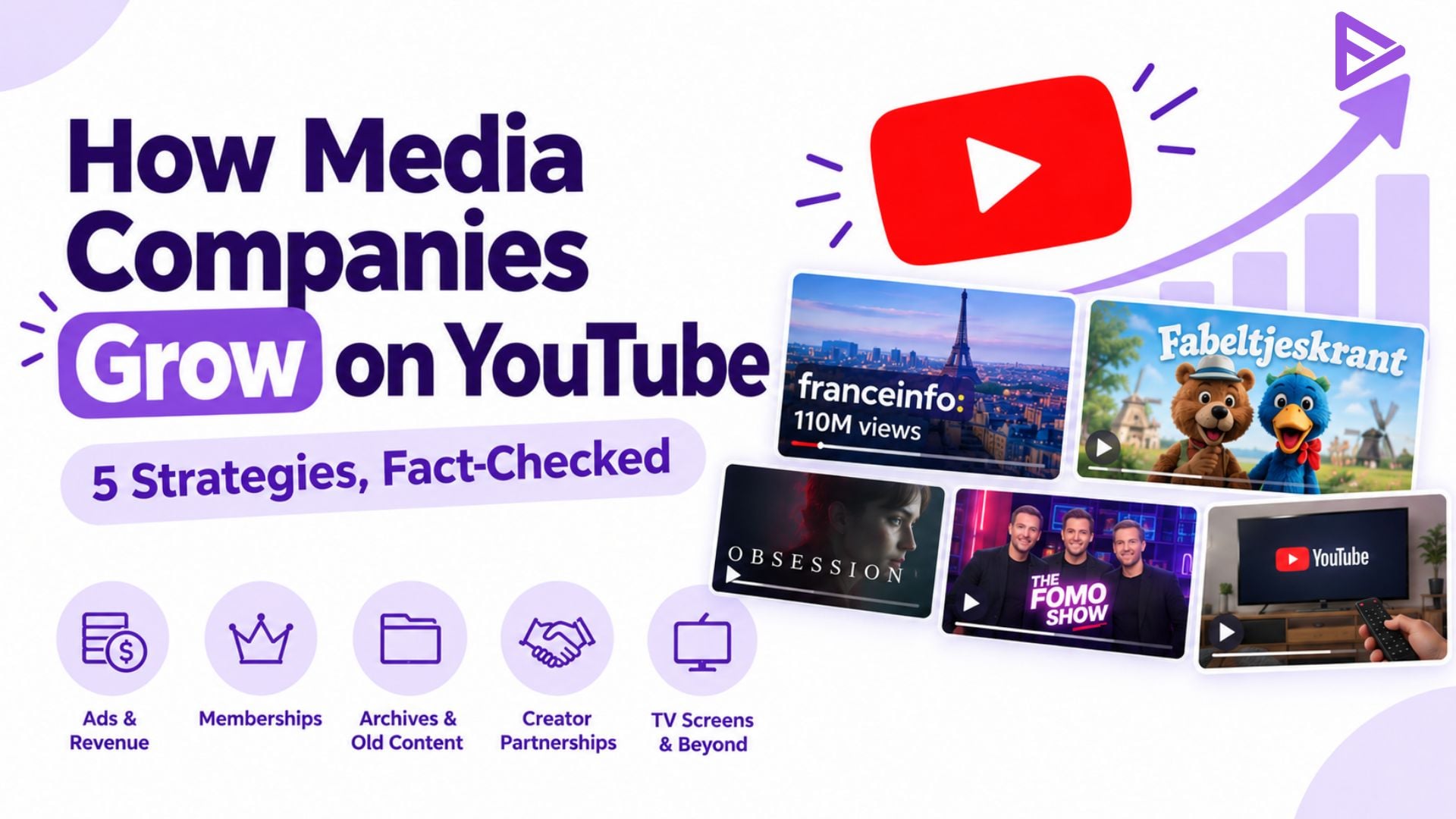
- Franceinfo’s YouTube channel drew 110 million views in September.
- Fabeltjeskrant’s 1,600 episodes are rolling out daily on YouTube.
- Obsession opened at $17.2 million and passed $400 million worldwide.
- The FOMO Show won the 2024 Televizier-Ring for online video.
- YouTube reported 1 billion daily TV viewing hours in 2024.
- YouTube frames its role as complementing broadcasters, not replacing them.
Media companies grow on YouTube in five ways. They earn ad revenue and sell memberships. They share archives and test ideas. They also partner with creators and target TV screens. YouTube laid out these five ways on October 28, 2026. This article checks each claim against independent sources. Only verified facts are included.
How Do Media Companies Make Money on YouTube?
Media companies earn from ads, direct ad sales and memberships. YouTube says they keep the majority of ad revenue. That matches the revenue share creators receive. Companies can also sell premium ad slots directly. Channel Memberships let viewers pay for exclusive perks. Auto-dubbing helps content reach new language markets. Content ID finds and monetizes uploaded intellectual property.
How Do Podcast Brands Like Goalhanger Earn Beyond Ads?
Goalhanger is a UK podcast company. Its shows include The Rest Is History. Others include The Rest Is Politics. Apple Podcasts named it 2025 Show of the Year. It was the first UK show to win. Goalhanger also sells a paid Rest Is History Club. Members get early access and bonus episodes. The Rest Is Football also ran daily on Netflix. That run covered the 2026 World Cup. Podcast brands now earn across several platforms.
Why Are Broadcasters Putting Archive Shows on YouTube?
Archive uploads help new viewers discover shows. YouTube says they often send viewers back to broadcaster apps.
What Did France Télévisions Gain From Its YouTube Deal?
France Télévisions signed a YouTube partnership in April 2026. It agreed to publish its news programs there. Franceinfo’s channel drew 110 million views in September. The group says that is eight times last year’s audience. Its best single day reached 5.4 million views. The 20h bulletin alone drew 23.2 million views.
Those figures come from Logicomix and Social Blade data. The group calls itself France’s top news destination on YouTube.
What Is Fabeltjeskrant and Why Is It on YouTube?
Fabeltjeskrant is a Dutch children’s series. It aired on Dutch television from 1968 to 1989. All 1,600 original episodes are returning to YouTube. The first 10 went live on August 19, 2026. One new episode follows each day. At that pace, the rollout takes over four years.
Robin de Levita, Monks and YouTuber Kwebbelkop led the restoration. AI upscaling improved the picture and sound. A new animated series is also in development. The case shows old libraries can find new audiences.
Can a YouTube Creator Direct a Box Office Hit?
Curry Barker did, with the horror film Obsession. Barker is half of sketch duo That’s a Bad Idea. He uploaded a horror short, The Chair, to YouTube. Producer James Harris then approached him about a feature. Barker pitched Obsession instead. A public YouTube upload led to a feature offer. Focus Features released it on May 15, 2026. It opened at $17.2 million from 2,615 theaters. Forecasts ran between $8 million and $10 million. The second weekend rose 39.4 percent to $23.9 million.
The film later passed $400 million worldwide. Reports put its budget near $750,000. TheWrap says it out-grossed all films budgeted under $1 million. That record is before inflation adjustment. YouTube’s post says Obsession made over $100 million opening weekend. Box office reports show $17.2 million instead.
How Do Broadcasters Combine TV Shows With YouTube Releases?
The Dutch FOMO Show offers one example. It airs under the broadcaster KRO-NCRV. New episodes stream first on NPO Start. YouTube versions follow a day later. The show began in 2021. It won the 2024 Televizier-Ring for online video series. Daan Boom and Tobias Camman have hosted since the start. Jasper Demollin left in 2025 after ten seasons. Stijn van Vliet replaced him. YouTube’s post presents the show as a creator partnership. The show is broadcaster-backed and released on both platforms. It shows TV and YouTube windows can work together.
Is YouTube Becoming a TV Platform? What Smart TV Data Shows
YouTube’s own data points that way. In the US, TVs are now YouTube’s top viewing device. YouTube’s annual letter says so. YouTube reported over 1 billion daily TV hours in 2024. YouTube introduced Multiview for Coachella in 2024. Viewers could watch up to four stages at once. Six stages streamed live that year.
Final Thoughts
This is a promotional post, so read it carefully. Several of its examples hold up under independent checks. Franceinfo’s growth and Fabeltjeskrant’s revival are well documented. Its Obsession figure, however, was wrong. Each example started with an existing asset. France Télévisions had news programs. Fabeltjeskrant had a classic archive. Barker had a short film. KRO-NCRV had an award-winning show. YouTube added reach to assets that already worked.
Creators can take one lesson from all of this. Own your audience across more than one platform. Pair video with written content to widen reach. VeeFly’s guide on growing blog traffic with YouTube shows how.
